Roger Q. Mason: A Timely Retrospective of History and Identity
Updated: Dec 2, 2025
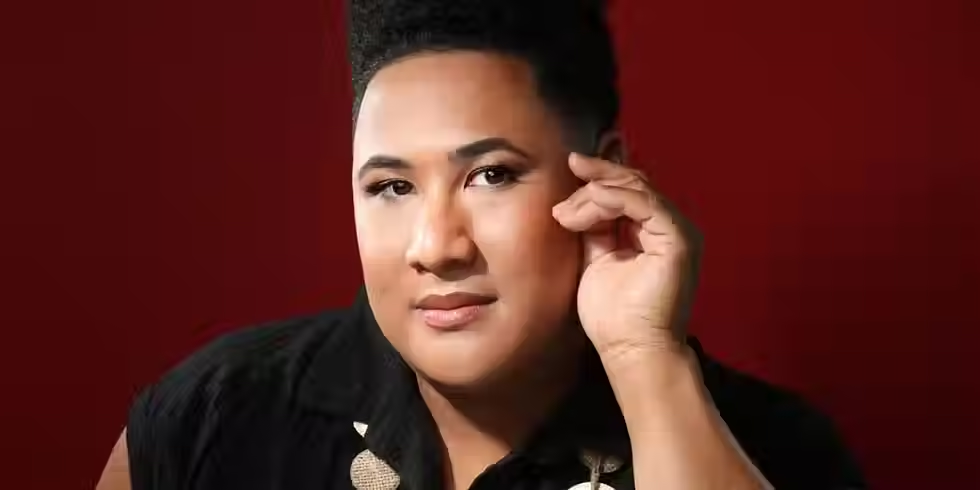
Award-winning Black and Filipinx playwright Roger Q. Mason is finally receiving well-deserved widespread recognition, marked by three major regional productions rolling out across the American theater landscape. Mason’s work uses a revisionist historicist lens, transforming complex histories into vivid, site-specific theatrical experiences that dialogue between the past, present, and future.
Mason’s three current productions, each a site-specific activation, include:
The Pride of Lions: World premiere at San Francisco’s Theatre Rhinoceros (ran earlier this month).
Lavender Men: Regional premiere at Chicago’s About Face Theatre (May).
The Duat: Regional premiere at Philadelphia Theatre Company (June).
History as a Survival Guide
Mason's writing challenges cultural biases that divide people. They recalled that their focus on historical, especially revisionist, work was not always popular when they began their career. They were often "criticized or encouraged to write about contemporary work" or questioned about the viability of historically based stories.
Mason defines history not as a static record, but as a "survival guide in the present to build the future." It is a source of drama and a means for the past to inform the present. This relationship to history was first nurtured at home, rather than in the academic settings of Middlebury and Northwestern.
Born in Santa Monica, California, and raised in Koreatown, Los Angeles, Mason grew up in a "time warp" Texas household. Their grandmother and two aunts, born between 1892 and 1910 in Del Valle, Texas, preserved narratives from the Reconstruction era, Jim Crow, and the Great Migration. Mason considers their playwriting to have begun at their grandmother’s yellow formica table, listening to tales, including one about her meeting Langston Hughes during his first tour of the South.
When Mason initially struggled to gain acceptance into graduate programs based on their applications and historical plays, they felt discouraged, believing their impulse to preserve history was deemed "not worthy of the academy." Undeterred, Mason held firm to their belief that these historical narratives were "the tools by which we survived in our present plight," arguing that writers have an obligation to record their survival stories for the next generation.
The Three Plays: A Trio of Reckoning
Each of Mason’s three plays confronts erasure and challenges narratives of the past:
The Pride of Lions:
Described by Mason as "a call to arms for us to speak the names of and celebrate the resplendence of trans, gender non-conforming, and gender-expansive people." It follows five female impersonators imprisoned for indecency after performing in Mae West’s 1928 play, The Pleasure Man. Its San Francisco premiere connected Mason’s work to a city with a long, resilient history of progressing LGBTQIA+ rights.
Lavender Men:
This historical fantasia features Taffeta, a queer, fat, multiracial femme who can conjure dead historical figures, including Abraham Lincoln and his young clerk Elmer Ellsworth. The play confronts issues of visibility, race, and queer inclusion, speaking directly to queer and trans audiences of color. The Chicago staging serves as a homecoming, as the city is where Mason conceived the play and grew into their queer identity, while also being closely associated with Lincoln. Director Lucky Stiff noted that the play's fantasia structure allows audiences to "imagine a past that could lead to a parallel future," with Taffeta claiming her place in the historical narrative as a matter of survival.
The Duat:
A solo performance portraying Cornelius Johnson, an FBI counterintelligence officer, as he fights for his soul in the Egyptian afterlife (The Duat). Johnson’s struggle centers on his career spent informing on Civil Rights activists in the 1960s. Staging the play in Philadelphia links the narrative, which is primarily set in L.A., to a city rich in Black history and cultural sites dating back to 1639. Director Taibi Magar, co-artistic director of Philadelphia Theatre Company, was drawn to the play’s inclusion of live drumming, dance, and movement, and its focus on Black discourse around Civil Rights and justice. Magar is excited to introduce the play—which will feature Black Out Nights and a Juneteenth performance—to Philadelphia’s "riveting, diverse, thrilling audience."
Art as Civic Medicine
Mason’s work, which uses historical fantasia to challenge the "absolute truth" of established narratives, arrives at a critical time marked by anti-LGBTQIA+ violence, censorship, and the continued racial reckoning since 2020. Mason defines truth as a kind of mythology—"an ordering of facts that helps us comprehend and digest the intangible."
This vision of truth draws collaborators like dramaturg Gaven Trinidad, who described Mason's writing as "just like jazz: beautifully structured chaos." Trinidad, who is also dramaturg for The Duat, noted that the play "shows the complexities around talking about race in the United States beyond our current vocabulary, and offers paths to healing through grace." The play confronts the various ways Black people viewed the Civil Rights and Black Power movements, including issues of colorism and violence within the Black community, while offering a message of transformation.
Mason writes with an inherited belief in civic patience—a challenge to audiences to question, heal, or process what they have witnessed, and an exercise for the playwright in waiting for people to catch up. Mason looks back on this journey, affirming that they "proceeded trepidatiously into a career that I knew would not always be popular but was necessary because it moved the people and it gave them the civic medicine that they may have not known that they needed."
As Mason’s work premieres across the country, they have achieved a space where they no longer have to defend their artistic choices. Instead, this period is an opportunity to relax, soften, and collaborate, offering audiences "a little taste of the sublime for them to do with it...whatever is necessary for their spiritual and social and cultural growth."