Aaron Tveit Takes on Fleet Street and Confronts the Terror of Sweeney Todd
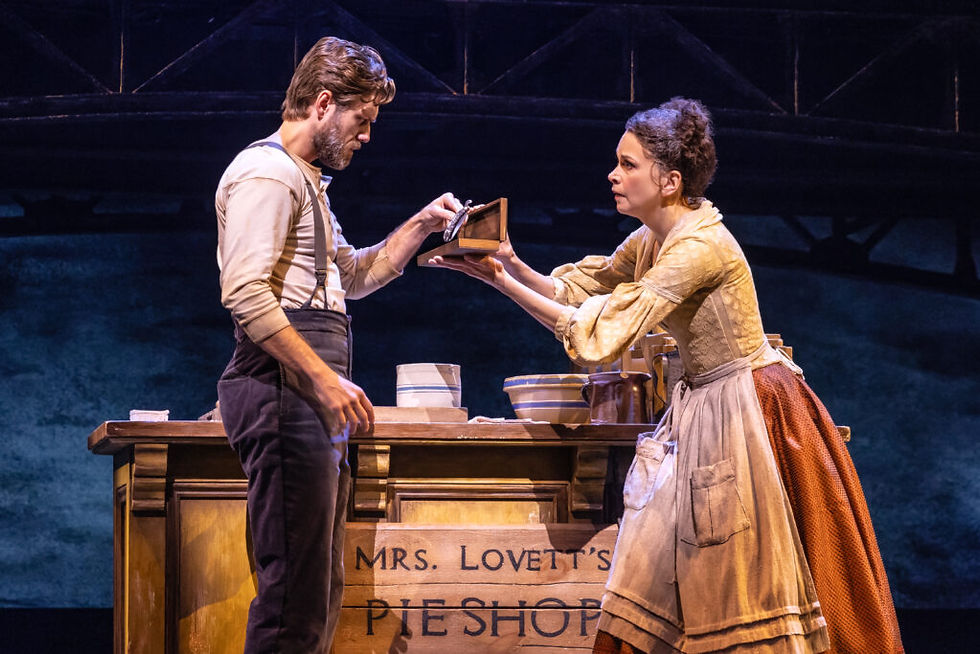
When Stephen Sondheim began writing Sweeney Todd, his stated goal was to "scare the hell out of the audience." For the actors who tackle the macabre musical, the feeling is often mutual. The complexity of Sondheim and Hugh Wheeler's score—which The New York Times once hailed as perhaps "the closest we’ve yet come to a genuine popular American opera"—makes the titular role one of Broadway’s most daunting challenges.
Aaron Tveit, the star of the current revival at the Lunt-Fontanne Theater (running in a limited engagement through May 5), readily admitted his apprehension. "People say, do things that scare you," Tveit said. "I was definitely scared about this role."
A Casting Twist: The Tenor Barber
The casting announcement last fall was surprising to many theater fans. Tveit and Sutton Foster, both renowned Tony-winning actors, replaced Josh Groban and Annaleigh Ashford as Sweeney Todd and Mrs. Lovett, respectively. Neither actor is typically associated with dark or villainous roles. Furthermore, the role of Sweeney is historically played by a baritone—a mold previously filled by originators like Len Cariou and subsequent performers such as George Hearn and Michael Cerveris. Tveit, known for his tenor voice, represents a distinct departure.
Tveit’s career has largely been defined by romantic leads, from Link Larkin in Hairspray and roles in Wicked and Catch Me If You Can, to his Tony-winning turn in Moulin Rouge! The Musical. While his role as a ghostly teen in Next to Normal offered thorny material, the menacing score and character of Sweeney Todd, rendered with Jonathan Tunick’s original 26-piece orchestrations, marks a significant change of pace.
Director Thomas Kail was inspired to cast Tveit after observing his intense focus and ability to own a well-known character during Grease Live! (also directed by Kail). "That is actually a very similar and necessary skill when you’re stepping in to play Sweeney," Kail observed, feeling Tveit would be a "great partner in this particular endeavor" to explore a new interpretation of the classic musical.
Finding Power in Unraveling
Although Tveit studied classical voice in college (before singing "lots of screaming high rock songs"), the ominous nature of the Sweeney Todd score is a sharp contrast to his typical soaring melodies. The team, including music supervisor Alex Lacamoire, was excited by the opportunity a revival offers for reinterpretation.
"The music is so intricate, so specific," Tveit noted. "It’s a wonderful challenge for me to tap into this part of my voice." Remarkably, very little of the score was adjusted for the tenor; they simply tweaked the key of "Epiphany" by raising it a half-step.
"Epiphany," which Sondheim once called a "schizophrenic breakdown," is the crucial moment where Sweeney converts from a heartbroken man seeking vengeance into a cold-blooded serial killer. Tveit approached the character by first focusing on his lost humanity, seeing the wronged man returning home as analogous to a superhero revenge backstory.
“His humanity is hanging on by a thread... All of the trauma, the PTSD that he’s been through in the past 15-plus years, starts to take over, and his humanity truly unravels.” — Aaron Tveit
Kail praised Tveit’s ability to navigate the "hairpin turns" in the first 15 minutes as Sweeney realizes his life’s purpose has dissolved. By the end of the first act, Tveit’s Sweeney finds his strength in that unraveling, achieving a power rooted in complete detachment: "It just happens that that power is, ‘I don’t care.’"
Hiding in Plain Sight
Tveit uses his traditionally charming persona and vocal type to his advantage, adopting the stealth and camouflage of a criminal who wouldn't draw a second glance. He intentionally leaned into a lower-class London accent during his scenes with the high-born Judge Turpin, allowing Sweeney to hide in plain sight.
Kail noted that this concept of light and shadow was central to their vision: "He walks into a crowd, and yet no one recognizes him... What do we see? What do we want to see?" Tveit suggested that he and Foster, both known for lighter roles, benefit from subverting audience expectation, making them "the snake in the grass."
Although the notion of a tenor Sweeney potentially shifted the show's direction, Tveit (who is the same age, 40, that Len Cariou was in 1979) ultimately credits the creative team’s trust and the brilliance of the source material.
"They let Sutton and I come in and do something very different, but the production still is the same production," Tveit said, arguing that the writing is so durable that it holds up to any "big choices." He believes Sondheim’s work, much like Shakespeare's, will continue to withstand reinterpretation for centuries, ensuring the terror and genius of Sweeney Todd endure.